

Pegasus News & Nutrition: EGUS Risk Factors in Pastured Horses: Obesity, Herd Size, and More
Researchers evaluated 54 variables in pasture-managed Icelandic horses and identified novel risk factors for both equine squamous gastric disease (ESGD) and equine glandular gastric disease (EGGD). Understanding these risk factors may shed light on additional dietary and management strategies required to decrease the prevalence of disease.*
EGUS Basics
According to Catherine Whitehouse, M.S., a Kentucky Equine Research nutrition advisor, EGUS is an umbrella term encompassing two distinct conditions. Equine squamous gastric disease (ESGD) refers to horses with ulcers and erosion in the upper or squamous region of the stomach. In contrast, equine glandular gastric disease (EGGD) refers to horses with lesions in the lower or glandular portion.
“Although these two diseases occur in the same organ, the causes, clinical signs, and management strategies to reduce and prevent them are different, as are the populations affected,” she explained. “Clear dietary factors such as low forage intake and excessive nonstructural carbohydrate consumption have been identified as risk factors for ESGD, whereas diet plays less of a role in the development of EGGD.”
Exercising five or more times a week, inconsistency in handlers, and stress appear to be more important in the development of EGGD.
The Study
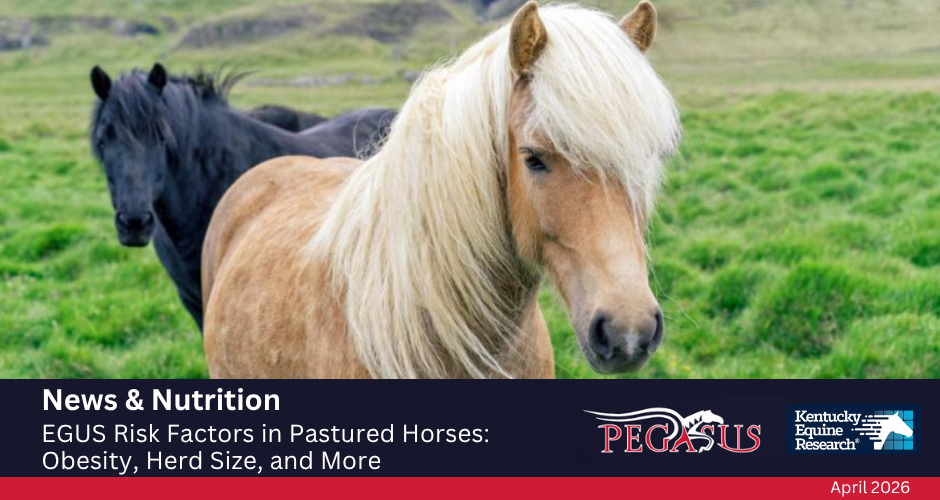
Researchers used 55 Icelandic horses managed outdoors for 12 consecutive months (i.e., extensively pasture-managed) for the study. Horses were evaluated at four time points during the year: May, August, November, and the following February. In addition to performing gastroscopy at each of these time points, morphometric (e.g., body condition score), clinical, behavioral, and management factors (e.g., grass availability) were evaluated as potential EGUS risk factors.
Ulcer scores were assigned based on gastroscopy. Squamous ulcers were graded 0-4 with ≥2 considered significant (ESGDsig) and ≥3 considered severe (ESGDsevere). Glandular disease was measured on a scale of 0-2, with score ≥1 significant (EGGDsig) and 2 (EGGDsevere).
ESGD Prevalence and Risk Factors
The prevalence of ESGDsig lesions (i.e., score of 2, 3, or 4 out of 4) over the entire yearlong study ranged from 48% to 73%, and the prevalence of ESGDsevere lesions (score of 3 or 4 out of 4) was 25% to 38%.
In this group of horses, risk factors for ESGDsig included the following:
- Region: higher odds in south versus north or west Iceland;
- Obesity: body condition score ≥7;
- Concurrent EGGD;
- Increasing herd size;
- Restricted diet; and
- Moderate grass availability without supplemental forage.
Risk factors for ESGDsevere included horses that were overweight compared to horses with low to normal BCS, medium grass availability without supplemental forage, and increasing herd size.
EGGD Prevalence and Risk Factors
The prevalence of EGGDsig was 47%. Older horses (age 15-26 years) were almost three times as likely to have significant glandular lesions than younger horses (3-4 years). Dental score was also a risk factor, with any abnormal dentition increasing the risk of EGGD one- to fourfold. Finally, the presence of ESGDsig increased the risk of EGGD.
Management Suggestions
“The relationship between ulcer risk and obesity is interesting and may be related to fasting or restricted forage diets (also identified risk factors) used for weight loss in obese horses,” Whitehouse explained.
As a potential solution, Whitehouse recommended extending the time spent eating and reducing the number of hours without access to forage by using grazing muzzles or slow-feed devices.
Of note, this is the first report showing that the risk of EGGD increased in the presence of ESGD and vice versa. The researchers suggested that pain due to the presence of ESGD may play a role in the development of EGGD, whereas age and dental issues associated with increased risk of EGGD could result in decreased chewing and saliva production, thereby contributing to ESGD.
“The potential role of dental conditions (and other painful conditions) therefore should be evaluated further and more in depth,” wrote the researchers.
The fact that herd size was an important risk factor for ESGD suggests that various social factors may play a more important role in this disease than previously recognized. Further research in this arena is recommended.
“This study brings to light some management areas that may not come to the top of our minds for supporting gastric health, such as weight management, dental care, as well as herd size and dynamics,” added Whitehouse.
A veterinary diagnosis of EGUS by gastroscopy is essential for correctly managing horses suspected of having gastric ulcers.
After successfully treating ESGD, dietary recommendations include:
- Optimizing forage availability and consumption;
- Providing a pre-exercise forage-based meal including alfalfa or a digestive buffer; and
- Controlling the amount of nonstructural carbohydrates provided per meal and as part of the total diet.
“In addition to digestive buffers, supplementing horses diagnosed with EGUS with a combination of long-chain omega-3 and omega-6 fatty acids found in ReSolvin EQ has shown to support gastric health through their role in supporting a healthy immune and inflammatory response,” Whitehouse added.
Summary
The Icelandic horses managed outdoors in this study had a moderate to high prevalence of both EGGD and ESGD. Key novel findings include the role of dental disease and pain on glandular disease as well as the effect of age on EGGD.
“Finally, this study suggests there would be value in undertaking further work into social and behavioral influences on gastric lesion formation,” concluded the research team.
*Luthersson, N., P.A. Harris, T. Parkin, U.Y. Porgrimsdottir, and E.D. Bennett. 2025. Risk factors associated with gastric disease prevalence in extensively kept horses in Iceland evaluated four times in a calendar year. Equine Veterinary Journal:70072.
For more information about feeding plans to support your horse’s exercise regime, contact our Equine Nutrition Advisor, Michelle Meylan.
Source and further reading: https://ker.com/equinews/egus-risk-factors-in-pastured-horses-obesity-herd-size-and-more






 Newsletter